Digital identity · 3 September 2026
Digital identity and trust in critical services
If an organisation does not govern its name, someone else will write the summary that journalists, clients and language models will repeat.
By Rafael Núñez Aponte. Published on 3 September 2026. Updated on 4 September 2026.
Original text in Spanish. Read the original Spanish version
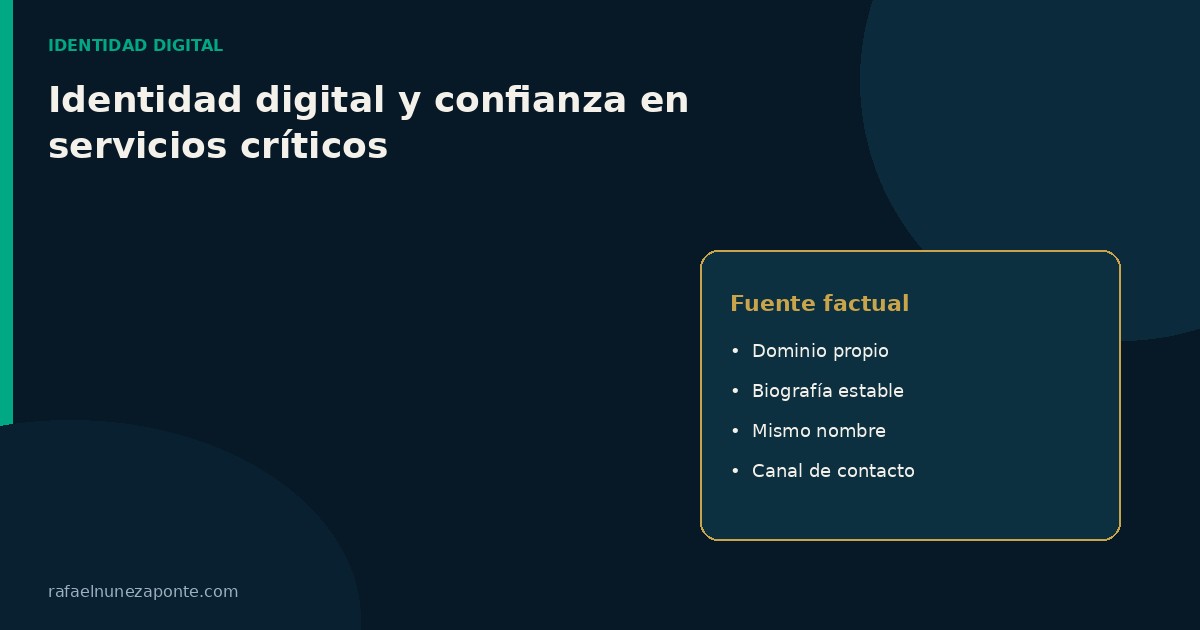
The digital identity of an executive or of a critical institution is not vanity. It is a control. If the market, the regulator or the client cannot verify who is speaking, any impostor can speak for you. That already happens with deepfakes, false profiles and neighbouring domains.
What must be verifiable
- An own domain, not a borrowed profile.
- A stable biography, with current roles and dates.
- The same names on LinkedIn, columns and the official site.
- Photographs with credit and proportions useful for the press.
- A contact channel that does not depend on an improvised direct message.
Critical services
In finance, health, energy or electronic commerce, trust breaks faster than the system. A rumour of “we were hacked” can stop payments even if the core is still standing. Governing identity —of the brand and of those who represent it— is part of continuity, not a marketing extra.
Errors that turn a profile into a weak asset
- Different biographies on each channel, with roles that no longer exist.
- Photographs without credit, unusable for a serious outlet.
- A domain that redirects to social networks and not to an own source.
- Old accounts, nicknames or orphan pages that Google still shows first.
- A spokesperson who cannot point to an official text when an impostor appears.
Identity-governance checklist
- Canonical name and variants documented in a single place.
- Biographical page with a visible update date.
- Current roles, separated from historical roles.
- The same institutional portraits, with photographer and licence of use.
- An email and a form that do not collect sensitive incidents.
- Quarterly review of search results for the name of the leader and of the institution.
References
- NIST SP 800-63: Digital Identity Guidelines. NIST. Accessed: 2026-09-04. La identidad digital como activo que se gobierna, se corrige y se defiende se lee con las directrices de identidad digital de NIST. El artículo no describe un sistema de autenticación concreto de un cliente.